Discover Your Dream Home in Just a Few Clicks •
The Smarter Way to Find Your Perfect Property •
Easily Find Homes That Match Your Lifestyle •

Real Estate vs. Stock Market: Where Should You Invest Your Money in 2025?
- 16 Jul 2025
- Property Bazee
- 0 Comments
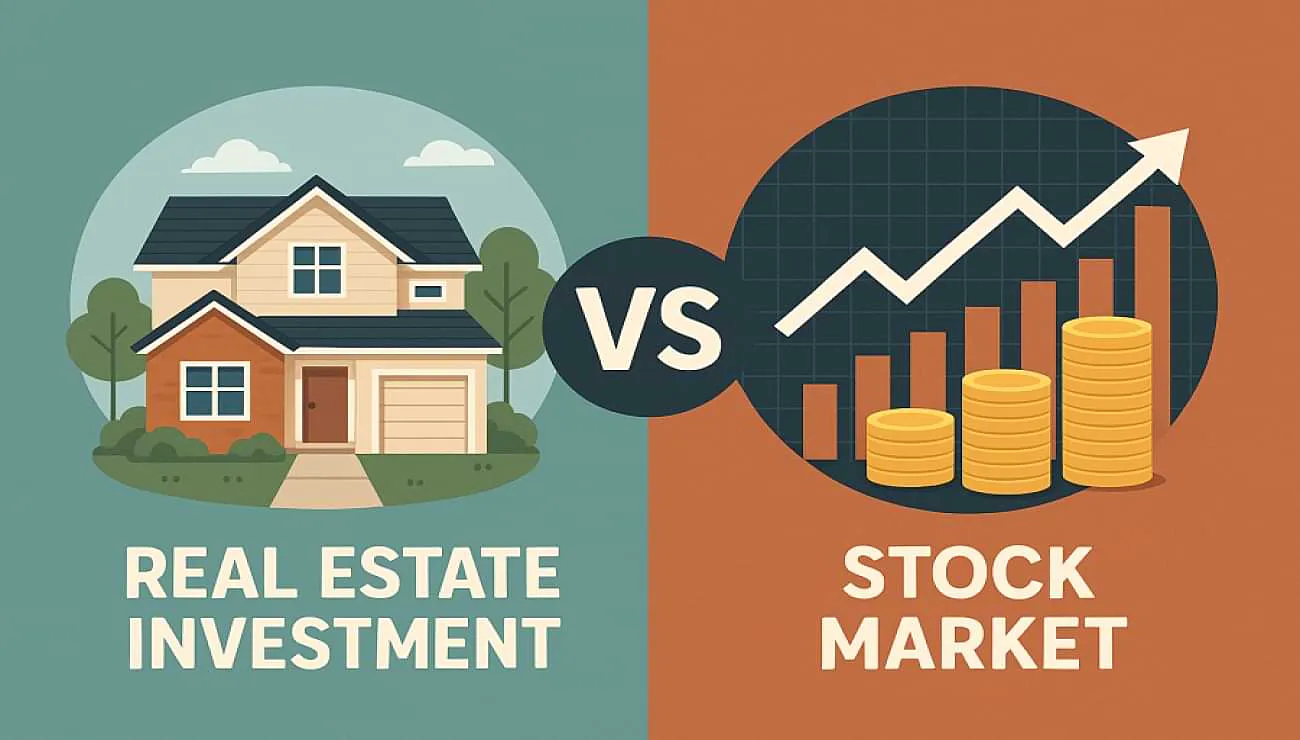
When it comes to building wealth, two investment options dominate the conversation: real estate and the stock market. Both offer opportunities to grow your money, but they come with different levels of risk, rewards, and responsibilities. As we step into 2025, many investors are asking the same question: Should I invest in real estate or the stock market this year?
In this guide, we’ll break down the pros, cons, and key differences between real estate and stock market investing so you can make the right choice for your financial goals.
Understanding Real Estate Investment
Real estate investment means buying property—residential, commercial, or land—with the goal of generating income (through rent) or appreciation (selling for profit later).
✅ Advantages of Real Estate Investment
- Tangible Asset – You own a physical property that often retains long-term value.
- Steady Cash Flow – Rental properties provide consistent monthly income.
- Appreciation – Property values generally rise over time, especially in growing markets.
- Tax Benefits – Mortgage interest, depreciation, and property tax deductions reduce taxable income.
- Leverage – You can finance properties with mortgages, boosting potential returns.
❌ Disadvantages of Real Estate Investment
- High Initial Capital – Down payments, closing costs, and maintenance are expensive.
- Low Liquidity – Selling property takes time and often comes with high fees.
- Management Hassles – Dealing with tenants, maintenance, and legal issues can be stressful.
- Market Dependency – Local economic downturns or regulation changes can hurt returns.
Understanding Stock Market Investment
Stock market investing means buying shares of publicly traded companies. This gives you ownership in a company and the chance to earn from capital gains (stock price growth) and dividends (profit-sharing payouts).
✅ Advantages of Stock Market Investment
- High Liquidity – Buy or sell stocks within seconds.
- Low Entry Point – Start investing with as little as a few hundred dollars.
- Diversification – Spread risk across industries, countries, or asset classes with ETFs.
- High Growth Potential – Historically, stocks outperform most asset classes long-term.
- Passive Investing – Index funds allow “set it and forget it” strategies.
❌ Disadvantages of Stock Market Investment
- Volatility – Prices can swing dramatically within hours.
- Emotional Risks – Fear and greed often lead to poor decisions.
- No Tangible Asset – Unlike real estate, you don’t own something physical.
- Dividend Uncertainty – Not all companies pay dividends consistently.
Real Estate vs. Stock Market: A Side-by-Side Comparison
|
Factor |
Real Estate Investment |
Stock Market Investment |
|
Initial Capital |
High (down payment + costs) |
Low (buy a single share/ETF) |
|
Liquidity |
Low – properties take time to sell |
High – instant selling |
|
Management |
Active – maintenance, tenants, taxes |
Passive – can be hands-off |
|
Returns |
8–12% annually (avg. rental + growth) |
10–15% annually (long-term average) |
|
Risk Level |
Moderate – market cycles & vacancies |
Higher – market volatility |
|
Tax Benefits |
Mortgage interest, depreciation |
Capital gains tax, dividend benefits |
Which Investment is Better in 2025?
Invest in Real Estate if:
- You want steady rental income.
- You prefer a tangible, long-term asset.
- You have enough capital for down payments.
- You want to leverage tax breaks and appreciation.
Invest in the Stock Market if:
- You prefer liquidity and flexibility.
- You want to start with smaller investments.
- You’re comfortable with short-term volatility.
- You prefer passive or automated investing.
A Smart Approach: Diversify Between Both
The best strategy in 2025 may not be choosing one over the other, but diversifying across both. Real estate offers stability and steady cash flow, while stocks provide growth and liquidity. Together, they create a balanced investment portfolio that can weather market ups and downs.
Conclusion
So, real estate vs. stock market—where should you invest your money in 2025?
The answer depends on your financial goals, risk tolerance, and investment horizon. Real estate provides stability and passive income, while the stock market delivers growth and liquidity. For many investors, combining both creates the strongest long-term wealth strategy.